

Arvind and Peak Sustainability Ventures pioneer India First Industrial - Scale Cotton Stalk Torrefac
In a landmark move for India’s textile and clean energy landscape, Arvind Limited and Peak Sustainability Ventures have unveiled the country’s first industrial-scale cotton stalk torrefaction facility in Gujarat. This breakthrough initiative marks a decisive step towards decarbonizing India’s textile value chain by transforming agricultural residue into a high-quality, drop-in thermal fuel that can directly replace coal in existing boilers.
Aligned with India’s national priorities and guided by multiple government programs supporting renewable energy and sustainable biomass usage, the initiative positions India at the forefront of circular and low-carbon manufacturing solutions.
Driving Circularity Through Advanced Torrefaction Technology
At the heart of this initiative is Finnish torrefaction technology, which converts cotton stalks—representing nearly 85% of the plant’s biomass—into a high-density, energy-efficient biofuel. This fuel is compatible with existing industrial boilers, eliminating the need for costly retrofits and easing the shift toward cleaner production.
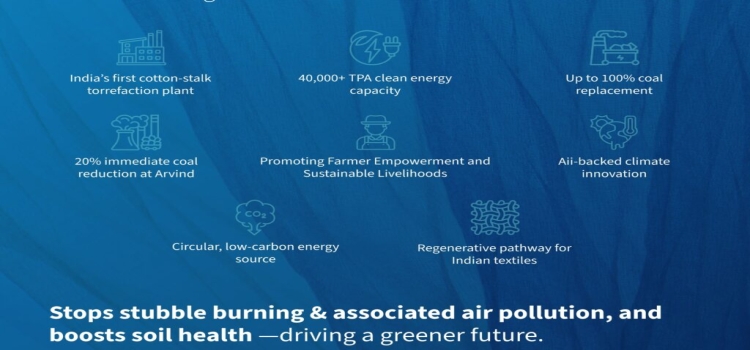
With an annual processing capacity of over 40,000 tons, the facility enables an initial 20% reduction in coal consumption, with a clear pathway to achieve 100% substitution. The initiative supports ex-situ residue management while offering farmers an additional revenue stream—turning agricultural waste into climate-positive energy.
Aligned with National Bioenergy and Climate Missions
The project is developed under the frameworks and vision of:
- Ministry of New and Renewable Energy’s National Bioenergy Programme & Biomass Programme
- Ministry of Agriculture & Farmers Welfare’s Crop Residue Management Scheme
- Ministry of Power’s initiatives supporting low-carbon energy transitions
Collectively, these programmes promote responsible biomass utilization, reduce open burning of agricultural waste, and strengthen India’s commitment to a resilient and scalable bioeconomy.
By integrating policy alignment, technology adoption, and farmer engagement, the project exemplifies how industry-led action can accelerate India’s climate goals.
Climate Leadership Through Technology and Collaboration
The partnership brings together Arvind’s extensive farmer network with Peak Sustainability Ventures’ technological and investment capabilities to deliver measurable emissions reductions. Torrefied biomass significantly enhances energy density, storability, and operability, making it a viable, reliable substitute for fossil fuels.
Supported by the Apparel Impact Institute, this initiative signals a major leap toward coal-free manufacturing by 2030—a target aligned with global climate imperatives and growing brand expectations for low-carbon supply chains.
Key Highlights of the Initiative
- Capacity: 40,000+ tons per annum
- Location: Gujarat
- Feedstock: Cotton stalks (≈ 85% of biomass)
- Coal Substitution: 20% initially, scalable to 100%
- Support: Apparel Impact Institute
- Goal: Achieve coal-free operations by 2030
Arvind Limited and Peak Sustainability Ventures’ pioneering torrefaction facility represents a powerful convergence of innovation, sustainability, and industry leadership. By transforming cotton stalk residues into a renewable, coal-replacing thermal fuel, the initiative not only reduces emissions but also strengthens circularity, farmer livelihoods, and India’s bioenergy ecosystem.
As global textile supply chains accelerate their decarbonization efforts, India now stands at the forefront with a scalable, technology-backed model that can be replicated across industries. The journey towards coal-free textile manufacturing by 2030 has begun—and this pioneering initiative is poised to reshape the future of sustainable production in India.